The Wheel of the Year
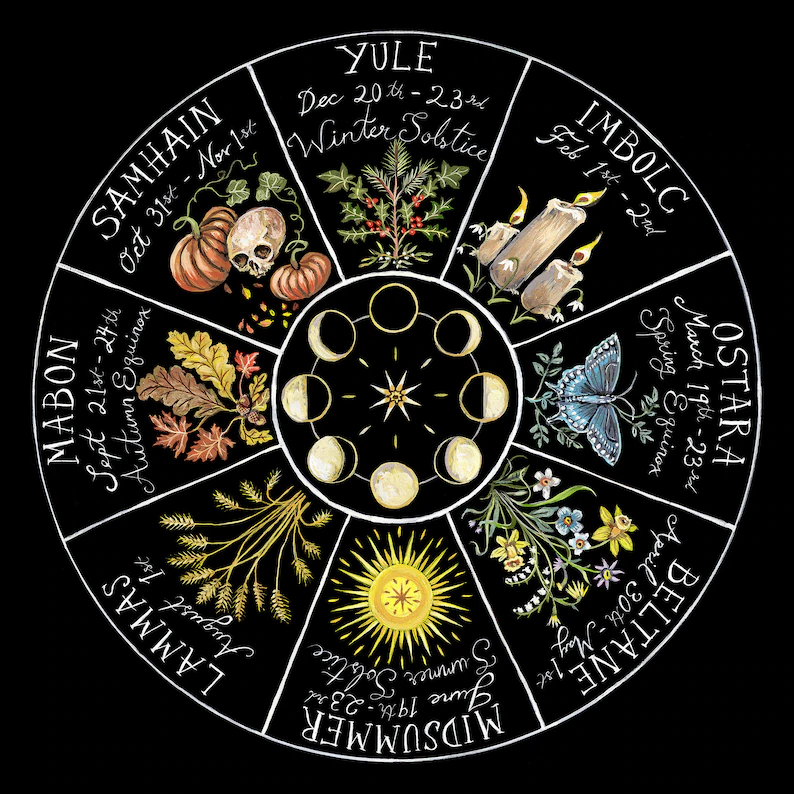
The Wiccan religion was founded by Gerald Gardner in the 1940’s, based on his study of older European pagan religions, and the existing occultism movement which began earlier in the century. In building a ritual calendar, he sought to honor the agricultural and astronomical holidays of older traditions, while also having a degree of symmetry throughout the year. He settled on eight roughly equidistant holidays throughout the year. Four to mark the solstices and equinoxes, and four spaced between them. All but one of these is an ancient pagan festival, observed in new ways by modern Wiccans.
At Fire Dance, we use the Wiccan calendar for our public rituals, because it pulls elements from a variety of traditions, and is the most well known and accessible pagan tradition in North America.
Samhain
Pronounced sah-win or sow-in, Samhain is the Gaelic name of what is commonly called Halloween today. This is the celebration of the final harvest, leading into winter. In America, our growing season is longer, so we have Thanksgiving after Samhain. But in most of Europe, this is the last harvest and therefore the last feast before Yule. The apples, gourds, and pumpkins associated with Samhain are the crops harvested late into the autumn.
This is the time to prepare for winter and reflect on the past year. Traditionally, we do not begin new endeavors around Samhain. It’s considered bad luck. Instead, this is the time to shed anything from the old year which no longer serves you, guilts and grudges, habits, and even ritual tools that need to be retired.
The new can begin at Yule when the sun is reborn. In the Celtic calendar, the year ends with sunset on Samhain, and the new year begins in the morning, setting Samhain night apart from the rest of the year, as a liminal space between one year and the next.
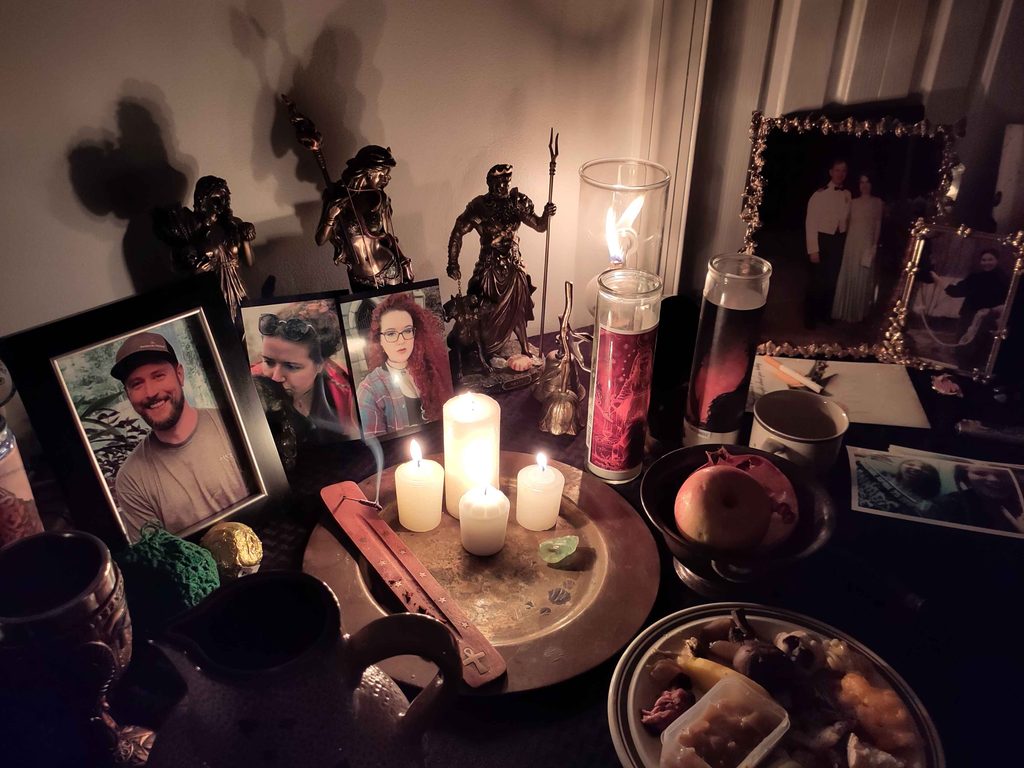
As the days grow shorter, the night dominates. This is when the Other World is closest to us. As winter’s chill brings death and slumber to the natural world, we honor those who have passed before us. This is a time to call on and honor our ancestors.
Often, Samhain is celebrated with a Dinner for the Dead, in which we invite beloved shades to join us for our feast, set extra places at the table for them, and eat in silence. Food may also be left on the doorstep or at a crossroads for the restless dead, and letters to the deceased burned in the hopes that they will respond, perhaps in a dream.
While this holiday focuses on death and the shades of the dead, it also reminds us of the immortality of the soul, and that all death is followed by rebirth.
The dead and assorted otherworldly beings are more free to interact with us on Samhain. The tradition of dressing up as monsters and trick-or-treating come from these beliefs.
If someone comes to your door on the night of Samhain, it’s best to be polite and give them an offering, because they might not be human, and if they aren’t pleased with your treat they’re liable to play tricks on you. So make sure you have some candy on hand.
If you have children, best to dress them up as ghosts and goblins so the spirits won’t kidnap them.
So if you’re a child, dress up as a monster and extort your neighbors for candy. While they’re inviting their dead relatives to join them for dinner.
Hekate and all other gods of death and the dead are associated with this holiday. I generally call upon Haides, Persephone, and Hekate for Samhain rituals.
Yule
Yule is the Norse and Wiccan name for the Winter Solstice.
As a Winter Solstice holiday, Yule is a festival of lights and a vital reminder in the depths of winter that the sun always returns and spring is always coming. Seasonal depression is endemic to the human condition, and a celebration of life at this time of year is desperately important to mental health, which is why almost all religions have a winter solstice holiday of some kind.
Symbolism in Yule celebrations often features the kindling of light in the dark, and the rebirth of a solar deity. Many of the aesthetics and traditions of Christmas are taken from ancient Yule traditions, including the decoration of trees, significance of holly and mistletoe, and the Yule log. Santa Claus was probably inspired by traditions featuring Odin and/or Cernunnos.
If possible, a live evergreen tree is a better decoration than a dead one. If a tree must be cut down, it’s possible to cut above the tree’s lowest branches, which will allow the tree to survive and grow back. If you have a live tree out doors, I advise against keeping gifts beneath it for obvious weather related reasons.
Yule celebrations are more meaningful without the commercialism common now in Christmas, so the best gifts are simple and hand made.
The Yule fire is sometimes lit from an unburnt portion of last year’s fire, continuing the endless cycle from one year to the next. This unburnt fragment of the fire is kept as a protective charm in the home until it is used and replaced next year. The ashes of the Yule fire also have protective power and may be scattered at thresholds or otherwise used for this purpose.
A simple charm for protection during dangerous times: Use the ash of the Yule fire to trace a pentagram on paper, roll the paper up and carry it in a red bag. When the danger has passed burn the paper.
Yule is a good time to replace ritual tools, such as candles, in preparation for the new year. Candle making and wand carving are good ways to celebrate the sabbat.
Some Yule rituals feature a symbolic battle between a Holly King figure representing the depths of winter, and an Oak King to lead the world into spring. Decoration with holly and English ivy (hedera helix) carries the same symbolism, as does using these materials in a Yule wreath to symbolize the wheel of the year.
Other rituals may reference the cauldron of Cerridwen as the symbolic darkness into which all dead and ending things must pass, and the source from which new life springs. This is a time for rituals and spells for the end of one thing and beginning of something new.
Imbolc
Imbolc is celebrated on February 2nd, halfway between the Winter Solstice, or Yule, and the Spring Equinox, Ostara. This holy day marks the beginning of the end of winter. Traditionally it’s around this time that snow begins to melt in Western Europe. As it turns out, often we have a sudden cold snap and more snow at this time in Shenandoah.
Imbolc is time to begin preparation for spring and the agricultural season, so the blessing and sharing of seeds is appropriate for the holiday, as well as preparation for any gardening or farming you intend to do in the spring. Imbolc is often associated with divination to determine when the weather will warm enough for farming. One ancient tradition in Europe involves monitoring the awakening of badgers from hibernation to predict the end of winter. In North America, the badger was replaced with a groundhog, and now we have Groundhog’s Day.
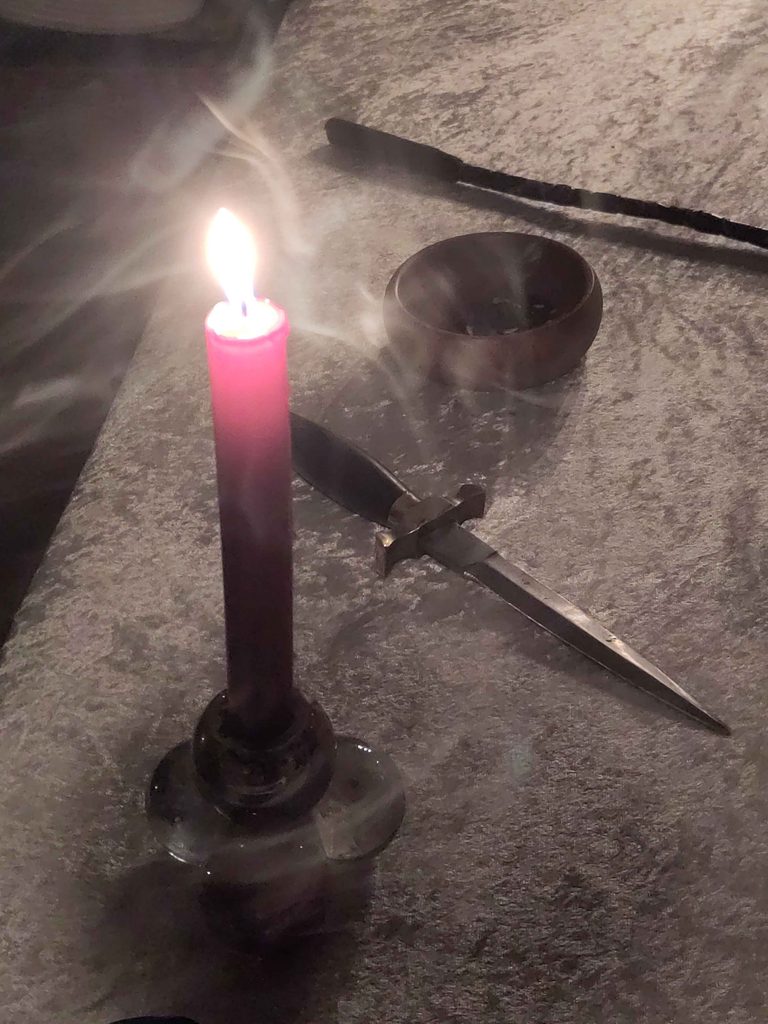
Another Imbolc tradition calls for the blessing of candles to be used throughout the year, a tradition which gives the name to the Catholic holiday of Candlemas. I make an anointing oil with scented oils to bless candles, and light them all from the Imbolc altar candles, each of which were lit their first time from the flames of other blessed candles, going back to candles used in pagan rituals in Ireland, from where this tradition comes.
As the snow melts and the seasons change it’s also time for old pattern in your life which no longer serve you to melt away with the snow.
The deity most associated with Imbolc is the Celtic goddess Brigid, who is the matron goddess of wisdom, poetry, healing, fire, and metallurgy. The Catholic church syncretized Brigid as St. Brigid, one of the patron saints of Ireland, and they also call Imbolc St. Brigid’s Day.
Ostara
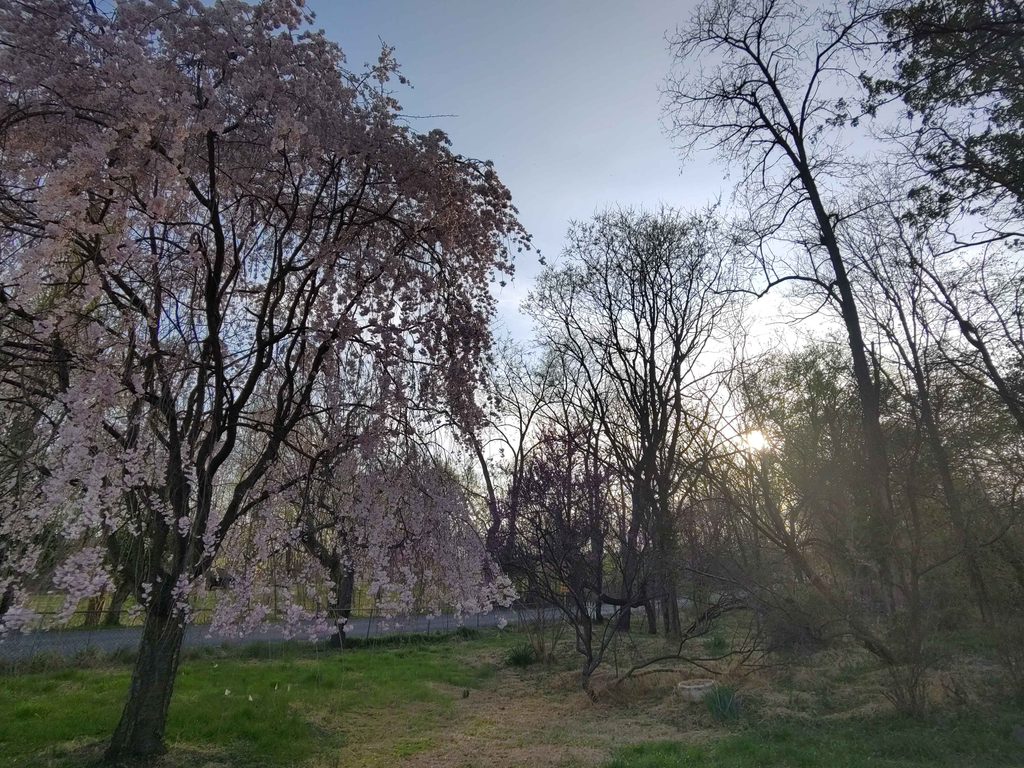
As we began preparing seeds at Imbolc, we begin to sow those seeds at Ostara. This holiday honors the vernal (spring) equinox, when the day and night are equal. It is the last day of the dark half of the year.
Beginning on Ostara, the light will last longer than the dark until the autumn equinox. The beginning of spring, this is a time of renewal and rebirth. It’s a time to make commitments for new beginnings and new projects, as in agricultural societies it’s a time to begin the planting season. Nights can be too cold still, so any literal seeds you plant will need to be kept indoors. This is a good time to ritually bless seeds in preparation for planting.
If you’re not the gardening type, this is still a time to plant metaphorical seeds. Bring your attention to what traits and changes you want to foster in yourself, and plant them in your subconscious.
This is a solar festival, often celebrated with fire. Traditionally, nine different woods are burned. Mid March, just before Ostara, is pruning season, so these woods can be set aside from pruning your trees.
Dyed eggs are heavily associated with Ostara (and Easter). This association likely relates to this being the time of year when wild birds are laying, and how early agricultural societies needed those eggs to supplement their diet after the winter. Often, children were sent to hunt for wild bird eggs. Hence the Easter egg hunt. Eggs also symbolize fertility, abundance, and rebirth. The art of basket making may have originated from watching nesting birds, so this art is also associated with Ostara. My formulary includes instructions for natural egg dyes.
Ostara as it is now, celebrated on the Vernal Equinox, is mostly a creation of Wicca, but it is heavily based on Saxon celebrations in honor of the goddess Eostre, goddess of spring and the dawn.
The deity most associated with Ostara is of course Eostre, but Persephone and Cernunnos are also appropriate.
Beltane
Celebration of Beltane begins at sunset on April 30th and carries on through May 1st.. Halfway between Ostara and Litha, Beltane, also known as May Day, is the height of spring. It is celebrated with dances and symbols of fertility.
Central to the ritual is often a bonfire, and the maypole.
By some traditions, the Beltane fire should be constructed of three pieces each of nine different types of wood, but that seems needlessly complicated to me. What’s important is that you have a bonfire.
In Pre-Christian Ireland, one central bonfire, or bale fire (also bael fire beal fire and bel fire) would be lit, and representatives from surrounding villages would light torches from this central fire, and carry them home to light their village’s fire. Finally, the residents of the village would light their hearth fires from the village bale fire. In this way, all the fires of the greater community shared a single source. In Scotland, two fires would be lit and cattle driven between them for purification and luck. Sometime Beltane rites include a dance involving jumping over a fire for similar reasons.
In the morning, festivities may begin with the May bowl, Sweet Woodruff blossoms filling a punch bowl, covered with a bottle or two of white wine, and a cup or two of strawberry wine or liquor. Add sugar to taste, and fresh strawberries if available. Pour some on the ground as an offering to the gods, and more for the faeries.
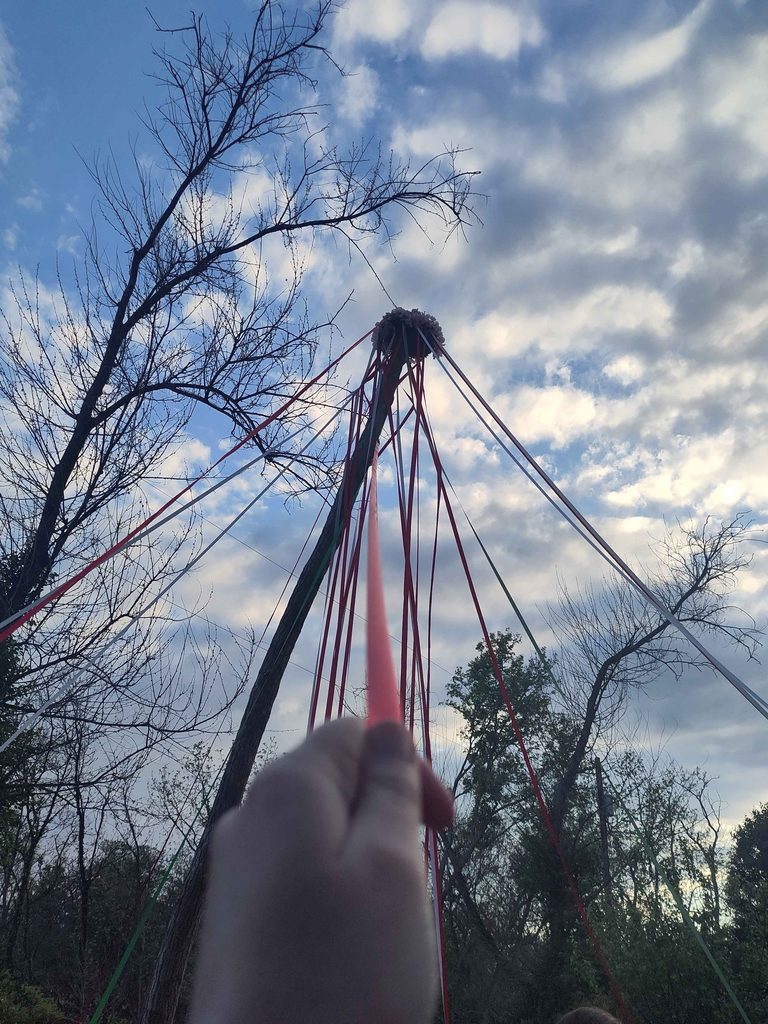
The maypole is usually a tree striped of its limbs and erected in the center of the ritual space. A fir tree is best if available, both for its evergreen symbolism and its straight trunk. The branches at the very top may be left on, or some other method must be used to very securely attach ribbons to the top.
Yes, it is intended to be a phallic symbol, as well as calling back to the symbol of the World Tree. A connection between worlds and symbol of rebirth and fertility.
Ribbons are hung from the top of the pole, and participants dance in opposite directions while holding the ends of the ribbons, weaving colored ribbons around the pole. Traditionally, women dance in one direction holding red ribbons (symbolizing menstrual blood) and men dance in the other direction with white ribbons (symbolizing semen). For personal and agricultural fertility. At Fire Dance we use many colored ribbons to include non-binary participants. Often, lovers will steal a kiss each time they pass each other around the maypole. Sometimes anyone wanting children will be intentionally tied to the maypole during the maypole dance (and cut out after the dance) as a charm for fertility. The one time we at Fire Dance tied a couple of newlyweds to the maypole, they had their first child nine months later.
You can find an accurate representation of the maypole dance in the movie The Wicker Man. (There is only one Wicker Man movie. That movie with Nicholas Cage was a horrible fever dream. It isn’t real, it can’t hurt you.)
In some traditions, a king and queen of May are elected to preside over Beltane rites. This practice sometimes ends in ritual sex, which may or may not be conducted publicly. This is a good time for all spells of creation and culmination, as well as sex magic.
May Day is a good time for spring cleaning. This is when Roman temples were cleaned. It’s also a good time for chimney cleaning.
In some traditions, women wear crowns of white flowers, and men wreaths of birch or poplar branches. Wreaths of these materials may be made for decoration, and burned on Midsummer.
Water sources are blessed in the month of May as well.
Herne and Cernunnos are among gods commonly called for Beltane rituals. At Fire Dance we make a deliberate effort to queer our rituals, and we call upon Dionysos and Aphroditos as queer fertility deities.
Litha
Lughnasadh